Showing posts with label National Styles. Show all posts

Saturday, 14 September 2013

Korean Traditional Costume - Historical Pieces


Today is the turn of some of the historical costumes displayed in the Korean Folk Museum in Seoul, South Korea.  If you're ever in the city, this place is worth of visit a thousand times over.  It's free to go in has many fascinating displays of various aspects of Korean life, mostly from pre-Modern times.  There's so much for any textile fan, but also plenty to interest family members and friends.

One of the main display halls is dedicated to the life cycle, starting with childhood, moving through marriage and even showing traditional funeral customs and artefacts!  Here we'll start with a look at the traditional wedding party.


Did you notice in the photo above, that the groom is wearing an embroidered panel on the front of his hanbok?  The museum holds quite a collection of these and a few of them follow.


Let's now move on to some of the cute little costumes for children.  As you can see, they mirror the adult versions quite closely.


Waving us a farewell is a lady in a relatively simple, everyday hanbok.  These can still be bought in Korea and several of the assistants in museum shops etc were wearing this kind of dress.  Lovely to see such beautiful traditions being kept alive!


Thank you for your visit!  I hope you enjoyed it.=)

Text and images © Elizabeth Braun 2013

Saturday, 7 September 2013

Traditional Korean Costume - The Modern Hanbok


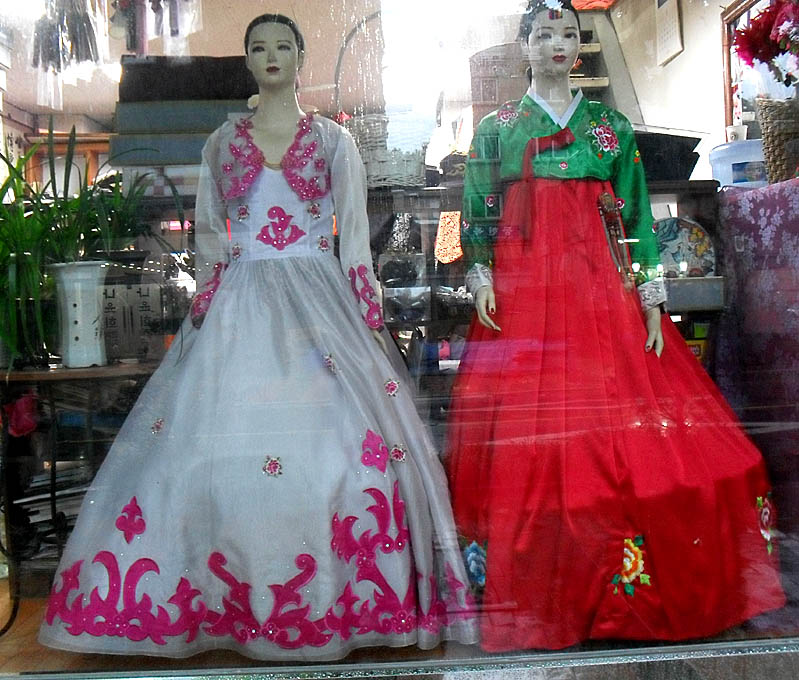
Recently I promised a post or two on traditional Korean costume, the Hanbok, and here's the first, showcasing both some lovely clothes on sale in Seoul, South Korea back in August 2010 and a Korean friend of ours here in the UK.

Of course, many of these first photos have been taken through display glass from the street, so please forgive the 'extras' and, in one of them, you can even see me taking the snap!!


Below are two close-ups taken through the gratings over the display window of a shop that didn't seem to open on Sundays (which was the weekday we were out and about on this street).  Long-time readers may remember these photos, but they don't grow tired for seeing them again, do they?  Wouldn't you just love to walk around in such a work of art?  I suspect these heavily embroidered Hanboks were wedding clothes.


Here is a lovely little Korean friend of ours Jenny who, like Sir and I, met her hubby Rob whilst studying in Taiwan.=)  She very kindly allowed me to take close ups of the embroidery on her wasitband and cuffs so I can share its beauty with you.


Next time I'll feature several of the historical costume pieces on display in the Seoul Korean Folk Museum.  In the meantime, I hope you've enjoyed this brief look at modern Korean traditional dress.

Text and images © Elizabeth Braun 2013

Saturday, 3 August 2013

Korean Embroideries


On the way home from our second year in Taiwan (2009/10), we made a 3 night stop in Seoul, capital city of South Korea.  Whilst we were there, I naturally took every opportunity of getting to know traditional Korean textiles and embroidery.  Sadly, we didn't have a lot of time and the Korean Embroidery Museum we went to didn't allow any photography at all, but here are some of the shots I managed to get (some not very straight, or with the glare of artificial lighting - sorry!) at the Korean Knot Museum, the Korean Folk Museum and in various souvenir shops near to our hotel showing embroidery, patchwork and traditional costume.


At first glance, many of these pieces may seem to resemble both Chinese and Japanese work, but there are distinct differences, one of which is that, unlike much of traditional Japanese work, only twisted silks are used to work the pieces, no flat, gloss silk.  Quite a bit of metallic outlining features as well.


Most of these patchwork pieces are worked using multi-coloured fabrics with a similar, self-coloured floral design, which you may be able to see in the white outer fabric of the cushion/pillow covers on the right.  Some are, as seen on the left and in the two cushions/pillows below, translucent/sheer fabrics.  Traditional Korean patchwork came about as a way to use up left over fabrics and even the tiniest pieces are used to make a pattern (see 3 photos above).  Both economical and attractive!  Who could ask for more?


I got a number of photos of traditional costume, including the wonderful embroidered panels that were made to be worn on the men's clothes.  A future post will showcase many of these.  In the meantime, I hope you've enjoyed this brief insight into the stitchcrafts of a nation often overlooked in favour of its more prominent neighbours, China and Japan.  Whilst they still maintain a distinctly Oriental flavour, Korean embroidery has a style of it's own and is truly beautiful.

I do hope we can visit Korea again and that I can get to visit the larger Korean embroidery museum and learn much more!  Have you been?  What did you see/like?  What other countries' traditional stitchcrafts most appeal to you?

Text and images © Elizabeth Braun 2013

 
Google+